

Industries / Banking & Financial Services
Banking & Financial Services operations need software shaped around the work.
Banking and financial-services operations require customer-defined confidentiality, review, traceability, access, and deployment boundaries before implementation.
Industry focus
Banking & Financial Services workflows
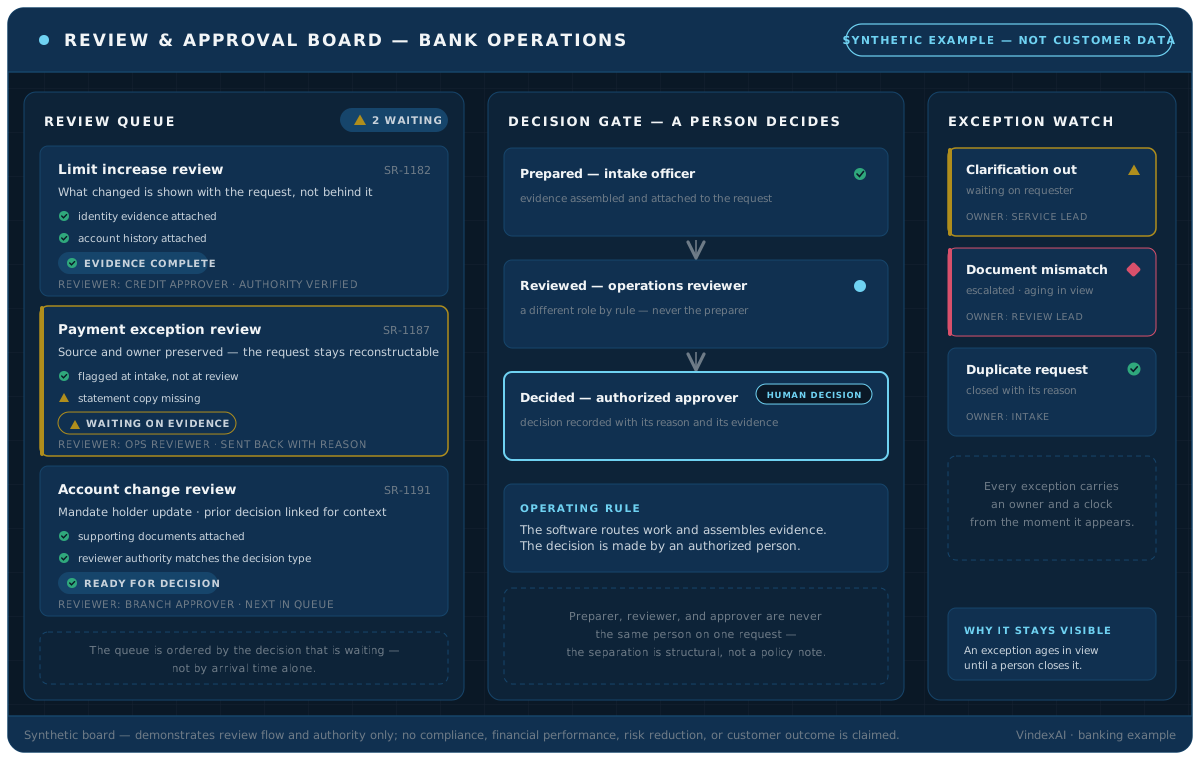
The constraint here is not throughput. It is that certain decisions must remain human, and the operating system has to make that boundary structural rather than a matter of policy.
Service-request routing
Classify a bounded request, preserve source and owner, expose missing information, and route the next review without automating the final decision.
- The final decision stays with the authorized human by design
- Missing information exposed at intake instead of discovered at review
- Source and owner preserved so the request stays reconstructable
Review and approval queues
Show what changed, which evidence is present, the authorized reviewer, and the decision still waiting.
- Queues ordered by what is genuinely waiting, not by arrival time alone
- The supporting evidence sits with the item under review
- Reviewer authority checked against the decision being asked for
Exception follow-through
Keep unresolved exceptions, requested clarification, aging state, and accountable next action visible across handoffs.
- Aging state visible before an exception becomes a service failure
- Requested clarification tracked as an open item with a named owner
How we serve the industry
Banking & Financial Services controls, Buyer questions, and Proof boundary
Boundaries are defined by the customer's own rules, not by an assumed regulatory posture. VindexAI maps to them rather than asserting compliance.
Operating controls
Map segregation of duties, access, approval authority, audit evidence, data location, and human override to the customer's rules.
- Segregation of duties expressed in the workflow itself, not in a policy document beside it
- Data location and deployment follow the customer's rules, including fully customer-controlled environments
- Human override preserved at every point where the customer's rules require a person
Buyer questions
Which queue lacks ownership, what decision must remain human, where must information stay, and what record supports review?
- Each question maps to a control the engagement must implement, so scoping stays honest
- No answer requires disclosing customer records or regulated data
Proof boundary
Demonstrations use synthetic records and make no claim of regulatory compliance, financial performance, risk reduction, or customer outcome.
- The absence of a compliance claim here is deliberate: compliance is the customer's assertion to make, supported by evidence