

AI Ops
Put frontier AI to work under human command.
VindexAI designs, builds, integrates, and operates AI systems across the leading frontier platforms. Start with an agent responsibility, an existing system, or a person or team that needs more capability.
Featured managed offering
VindexAI Agent Operations
Agents and agency lead this offering. Specialist agents take defined missions through a governed coordination layer with Responsibility Charters, customer command visibility, human authority and stop controls, and bounded pilots before expansion.
Synthetic responsibility board
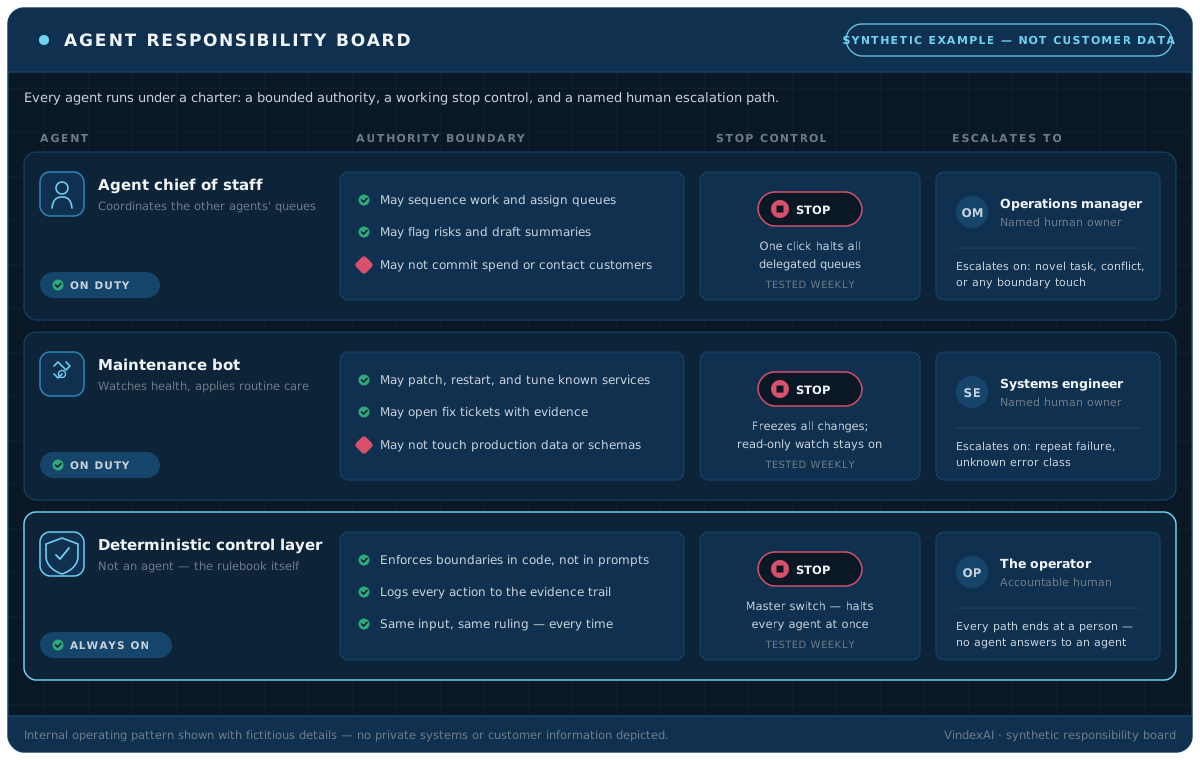
SC4 Agent Chief of Staff
Owns and orchestrates the assigned client responsibility within explicit authority and evidence boundaries.
Maintenance Bot
Monitors system and Chief of Staff health, executes authorized recovery routines, and escalates exceptions.
Deterministic control layer
Provides heartbeat, supervision, recovery, logs, alerts, permissions, evidence, stop controls, and human escalation.
Operating proof
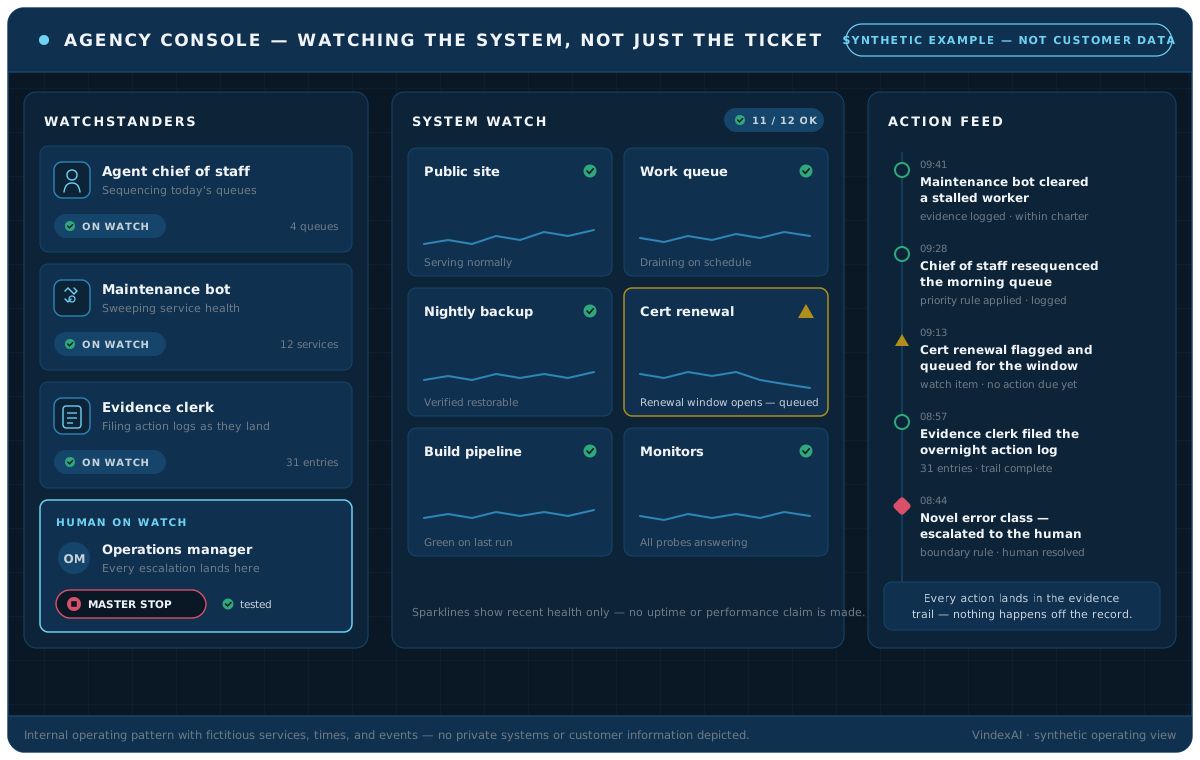
Meet the agency that runs our agency.
They watch the system—not just the ticket. Our first line of defense for the systems that run the business. The agency serves seven mission classes.
Internal operating pattern presented without private systems or customer information
The Mission Director
Our specialist agents operate across our own business under one coordinating role: the Mission Director. It orchestrates recurring operations, routes questions to the right specialist, and holds every mission to its Responsibility Charter — while authority, stop controls, and final decisions stay with a person.
- The director is a role, not a person — every escalation still ends at a human
Operate
Execute bounded recurring responsibilities across approved business functions.
- Each responsibility runs inside its Responsibility Charter—never beyond it
Assist
Answer bounded questions, retrieve internal information, and help people work through problems.
- Questions outside the approved boundary route to a person
Research
Search approved internal and external sources, compare evidence, and brief the operator.
- Findings arrive as briefs with sources the operator can check
Ideate
Explore alternatives, challenge assumptions, and develop possible approaches for human review.
- Options land as proposals; people decide what is adopted
Observe
Measure the heartbeat of systems, integrations, automations, and operating controls.
- Operating signals feed the reliability loop below
Diagnose
Contain failures and apply proprietary engineering models based on time-tested principles to investigate causes rather than symptoms within authorized boundaries.
- Causes are established before any fix ships
Correct
Develop countermeasures, deploy an approved solution, verify recovery, and reduce recurrence.
- Closure requires verified recovery and a control against recurrence
Client-provided role names
Clients provide role-specific names for their agents. The name makes an agent easier to recognize; the Responsibility Charter defines what it is allowed to do. Customer-facing names receive review for respect, trademark risk, impersonation, and false endorsement before deployment.
One reliability loop
From first signal to verified recovery.
The mission classes feed one working loop: Observe → Detect → Contain → Diagnose → Countermeasure → Deploy → Verify → Control. The loop closes at verified recovery and a control against recurrence—not at a closed ticket.
First line of defense for IT operations
Our agents are the first line of defense for IT operations because IT touches every other operation in the business.
- Human authority and stop controls sit above every stage of the loop
Ahead of the ticket, honestly stated
Because the agency watches the system—not just the ticket—some failures can be detected, contained, and corrected before a person reports them.
- Proactive-detection examples are substantiated through monitoring logs, incident records, diagnosis records, deployments, and post-fix verification
Recovery proven, recurrence reduced
A correction counts only when the countermeasure is deployed, recovery is verified, and a control that reduces recurrence is in place.
Platform selection by mission
The frontier platforms we work across
We are not a one-model shop. The operating combination follows the mission, data, tools, security, speed, cost, and customer environment.
OpenAI
ChatGPT and Codex.
Anthropic
Claude, Claude Code, and Claude Cowork.
Gemini.
xAI
Grok.
What VindexAI adds
The platform provides intelligence. VindexAI gives it a governed responsibility.
Boundaries
Mission design, proprietary-data boundaries, system access, and explicit authority.
Control
Human approvals, evidence, audit trails, command visibility, and stop controls.
Continuity
Deployment, monitoring, maintenance, recovery, and measured improvement.
Command view
Command visibility, stop controls, and evidence surface in operator-friendly boards suited to the responsibility.
Explore Smart Dashboards & BoardsPlatform-selection doctrine
Platform selection follows the mission—not a universal vendor ranking.
Choose the operating combination by responsibility and outcome, reasoning profile, required tools and integrations, data sensitivity, deployment boundary, media requirements, latency, reliability, cost, customer cloud and identity, vendor terms, and required human review.
Mission and environment
Match coding, computer use, applications, integrations, data boundaries, and deployment to the responsibility.
Operating constraints
Review reliability, latency, cost, availability, vendor policies, identity environment, and human control together.
Choose the use case first
Three starting paths.
Enable a person or team
Use platform selection, working methods, training, and governed adoption to add personal or team capability.
Give an agent a responsibility
Define recurring work, authority, systems, evidence, and a bounded pilot before expansion.
Apply AI to existing systems
Begin with the business outcome, current systems, proprietary data, workflows, controls, and safe integration boundaries.
Featured managed-offer path
Move from discovery to bounded operations.
The commercial ladder sits beneath the broader AI Ops practice and expands only with explicit evidence and authority.
AI Ops Discovery
Define the mission, operating environment, fit, and decision boundary.
Book an AI Ops discoveryResponsibility Charter
Document responsibility, authority, systems, evidence, review, and stop controls.
Bounded Agent Pilot
Exercise the charter within a limited operating scope before expansion.
Ongoing VindexAI Agent Operations
Operate, monitor, review, and improve the accepted responsibility under human command.
A tested foundation
We did the R&D before your project begins.
VindexAI research and development spans Google Workspace engineering, Microsoft 365 engineering, websites, web applications, and agent systems—testing architectures, integrations, routines, failures, and operating controls on our own systems. Clients begin with the known routines and reusable patterns that survived that work, not with a blank page.
Internal R&D evidence from our own systems — not customer outcomes, and no customer data
The agency that runs our agency came out of this work
The supervision, heartbeat, recovery, evidence, and stop-control patterns described above were built and hardened on our own operations before being offered to anyone else.
- Honest outcome — the operating patterns we offer are the ones we run.
- Limitation — internal operating evidence, not a customer result.
Platform work stays R&D until validation completes
Work such as the SynCORE 4Q Microsoft 365 Graph adapter is labeled by evidence: it remains research and development until parity validation completes.
- Limitation — R&D status is a boundary statement, not a delivery date.
This website ships from the same tested patterns
Every public sentence on this site comes from a version-controlled page contract and passes an automated claims gate before it can publish—patterns proven here before they are proposed elsewhere.
- Honest outcome — the Proof page publishes internal negative results and their corrections from this same work.
You should not have to hire someone to rediscover what we have already learned.
The value of the R&D is the discovery a client no longer has to fund: known routines, reusable patterns, and failures already found and corrected on our side of the boundary.
Fit before technology
Discovery can conclude that AI is not the correct solution.
Bounded before broad
A defined pilot establishes evidence before responsibilities or systems expand.