SC4 Enterprise
One operator. Six businesses. Zero staff.
The Challenge
A single operator running multiple businesses with no safety net.
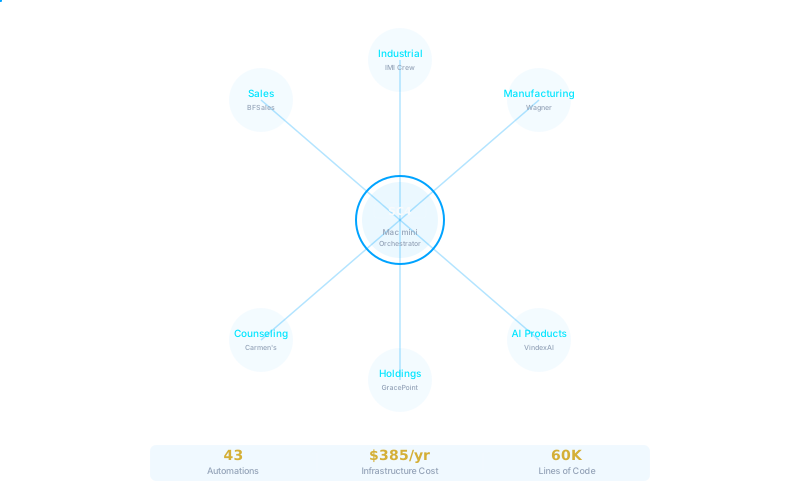
Six simultaneous enterprises. Industrial services with field crews and invoicing. Manufacturing sales with engineering quotes and corporate approvals. AI product development with Firebase deployments. A proprietary sales methodology. A counseling practice with multi-state licensing. A holding company tying it all together.
One person. No staff. Every ball dropped is a ball nobody picks up.
The traditional answer is hiring. A bookkeeper, an ops manager, a project coordinator, an admin assistant — four people minimum at $326K–$424K per year. A fractional COO still runs $60K–$200K. SaaS tools create data silos. Every new platform adds another login, another monthly bill, another integration to maintain.
The owner becomes the bottleneck. The businesses can only grow as fast as one person can context-switch between them. And at that pace, things fall through the cracks. Invoices go unsent. Follow-ups get missed. Opportunities die in inboxes.
By the Numbers
Verified production metrics from the live SC4 deployment.
The Solution
A Mac mini running the entire back office.
AI Orchestrator
An AI orchestrator codenamed Ike sits at the top of the stack. It parses every incoming request, detects which enterprise it belongs to, and routes it to the right execution path. For complex builds, it spawns autonomous sub-agents scoped to individual containers. For quick lookups, it responds directly.
The result: 29 autonomous build flights with an 89% first-pass success rate. Industry benchmarks for AI agent task completion sit between 5% and 30%.
Autonomic Nervous System
n8n workflows run as the always-on automation layer — the autonomic nervous system that handles what doesn’t need human attention. Email triage, financial exception detection, CRM synchronization, calendar coordination, and self-monitoring all run on deterministic schedules.
Seven core workflows execute continuously, from every 15 minutes to daily aggregation. If a workflow fails, the self-monitor catches it within 30 minutes.
Live Workflow Schedule
Local-First
All data stays on your hardware. SQLite databases in WAL mode as single sources of truth. No cloud dependency for core operations. No vendor lock-in.
Container Isolation
Each enterprise operates in its own container with scoped permissions. Sub-agents cannot cross boundaries. Credentials are domain-locked. Failures are contained.
Mission Autonomy
One approval, then execute to completion. No check-ins between steps. Self-correction on failure with at least two alternatives before escalation.
The Methodology
Systematic waste elimination applied to small business operations.
Discovery
A full value stream map identified 33 hours per week of automatable work across all six enterprises. At loaded labor rates, that represented $30,700 per month in operational waste — time spent on tasks that follow deterministic rules and require no human judgment.
Build Strategy
Rather than buying six different SaaS platforms, the approach was to build deterministic pipelines for every repeatable process: email triage and routing, financial exception detection, invoice lifecycle management, CRM synchronization, calendar coordination, and event-driven alerting. Each pipeline follows the same pattern — detect, classify, route, execute, verify.
Code Velocity
The system produced approximately 50,000 lines of production code in March 2026 alone — roughly 1,700 lines per day. For context, a typical professional developer produces 5,000 to 15,000 lines of code per year.
The total codebase now exceeds 60,000 lines of live production code across automation scripts, workflow definitions, database schemas, API integrations, web applications, and deployment configurations.
Quality Control
Every failure gets a root cause analysis. Five-Why minimum on significant errors. Countermeasures must be permanent and verifiable. The system error-proofs itself structurally rather than relying on discipline — poka-yoke over process compliance.
Results & Impact
What changed when the back office became a machine.
Replaced Roles & Annual Cost
Before
- × 33 hrs/week spent on automatable tasks
- × $30,700/month in operational waste
- × 8% process cycle efficiency
- × Manual email triage across 5 inboxes
- × Invoices, follow-ups, and opportunities falling through cracks
After
- ✓ 43 automations running 24/7 on a single Mac mini
- ✓ Fraction of the cost of traditional staffing
- ✓ Targeting 60%+ process cycle efficiency
- ✓ Deterministic email routing with auto-classification
- ✓ 89% first-pass success on autonomous builds
Ready to Replace Your Back Office?
SC4 Enterprise is a proof of concept for what AI orchestration can do for lean operators. If you're running a business where every hour matters, let's talk.