The Deterministic AI Thesis
April 2026 | 9 min read

Everyone is selling AI. We sell AI-engineered deterministic systems. There's a difference.
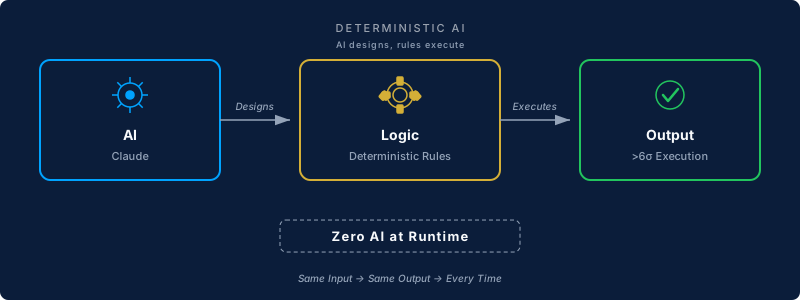
That difference is not subtle, and it is not marketing. It is a fundamental divergence in how we think about what AI is for. The industry consensus says AI belongs in the execution path—reasoning at runtime, making decisions on the fly, generating outputs probabilistically with every request. We disagree. We believe AI's highest value is as an architect, not an executor. And the systems it designs should run without it.
This is the Deterministic AI Thesis. It is the foundation of everything we build at VindexAI, and it explains why our systems deliver outcomes that probabilistic AI cannot match.
The $200 Billion Question
Global AI spending has crossed $200 billion annually. The money is chasing autonomous agents, bigger models, longer context windows, more reasoning tokens, and increasingly complex inference chains. Every quarter, the frontier models get more capable. Every quarter, enterprises spend more on API calls.
But ask the operators—the people who actually run payroll, route emails, manage inventory, process invoices, enforce compliance—what they need from a system, and the answer is remarkably consistent: reliability. They need the same input to produce the same output. Every time. Not 97% of the time. Not "usually, unless the model hallucinates." Every single time.
The market is pouring billions into making probabilistic systems slightly more reliable. We took a different path. We use probabilistic systems to build deterministic ones. The AI does the thinking once. The system does the executing forever.
The Paradox
AI is probabilistic by nature. Every inference is a sampling event. Temperature settings, token distributions, context window positioning—they all introduce variance. Run the same prompt twice and you may get two different answers. This is not a bug. It is the mathematical reality of how large language models work.
Operators need deterministic by requirement. Regulators demand audit trails. Finance requires reproducible calculations. IT governance mandates traceable decision logic. The operational world runs on rules, and rules do not have confidence intervals.
The conventional approach tries to solve this by making probabilistic systems more constrained—guardrails, validation layers, output parsers, retry loops, human-in-the-loop checkpoints. All of these add complexity and cost while asymptotically approaching but never reaching true determinism.
Our approach resolves the paradox entirely. We do not try to make AI deterministic at runtime. We use AI's probabilistic strengths—pattern recognition, system design, logic generation—at design time, and then we deploy systems that are deterministic by construction.
"The market is trying to make probabilistic systems more reliable. We use probabilistic systems to build deterministic ones. That's not an incremental improvement. It's a category shift."
The Three-Layer Architecture
Every system we build follows the same architectural pattern. Three layers, each with a distinct role and a clear boundary.
Layer 1: AI as Architect
Claude analyzes requirements, identifies patterns in data, models business logic, and designs the rules, workflows, data pipelines, and decision trees. This is where AI's probabilistic strengths—creative pattern recognition, complex system modeling, nuanced tradeoff analysis—deliver maximum value. The AI works at design time. It studies the problem, proposes the architecture, and generates the logic. Then it steps out of the critical path.
Layer 2: Deterministic Execution
Python scripts, SQL queries, Power Automate flows, shell scripts, VBA macros—these are the execution layer. Pure logic. No model inference. No API calls to AI services. No token consumption. The system runs the rules that AI designed, and it runs them identically every time. Same input, same output. By definition. The cost per execution is zero. The latency is milliseconds. The reliability exceeds Six Sigma because there is no probabilistic component to fail.
Layer 3: AI as Edge Handler
The deterministic system handles 90-95% of inputs. The remaining 5-10%—truly ambiguous, novel, or complex cases that no rule can cleanly resolve—get routed to AI inference. But critically, the system decides what is ambiguous using deterministic logic. AI only touches what rules cannot handle. This is not a fallback. It is a design choice that keeps AI where it adds value and keeps it out of paths where it introduces risk.
Three Proof Points
Banking: AI-Designed Logic, Zero AI in Production
A global bank needed client segmentation — a project we detail in the Global Bank Segmentation case study — for their relationship management team. IT compliance banned AI from the execution path—no cloud AI APIs, no model inference on client data, no probabilistic decision-making on regulated records. The system had to be auditable, explainable, and deterministic.
We used Claude to model a 6-tier behavioral scoring algorithm based on transaction patterns, account tenure, product adoption, engagement frequency, referral activity, and revenue contribution. Each tier has explicit thresholds. Each scoring dimension has documented weights. The entire system was deployed as an Excel workbook with VBA automation. Bank IT approved it because there is no AI in the execution path—just formulas and macros running rules that AI designed. The segmentation runs nightly across 40,000 client records. Cost per run: zero. Accuracy: 100% reproducible. Every score is traceable to specific inputs and specific rules.
Corporate: AI-Designed Automation Behind CrowdStrike
A Fortune-adjacent industrial manufacturer, needed workflow automation across their sales engineering operation. Their IT environment was locked down—CrowdStrike on every machine, no external API calls, no cloud AI services, no unapproved software. Power Automate and SharePoint only.
Claude designed the entire automation suite from outside the corporate network. A 9-step RFQ workflow. A 3-layer email architecture for bid management. A tracking dashboard for pipeline visibility. Power Automate flow definitions generated from AI-modeled logic. The result deployed natively inside Microsoft 365 with zero external dependencies. AI never touches a leading industrial manufacturer's corporate network. It designed the system from a MacBook. The system runs inside the corporate perimeter on approved Microsoft tooling. CrowdStrike sees nothing because there is nothing to see—just native Power Automate flows executing deterministic rules.
Operations: 661 Lines, 7 Steps, Zero Inference
Our own SC4 operational intake pipeline processes hundreds of records daily. It is 661 lines of Python executing 7 sequential deterministic steps: schema validation, type coercion, referential integrity checks, SHA-256 deduplication, keyword-based routing, conflict resolution, and write confirmation. Every step is a rule. Every decision is logged. Every record gets identical treatment.
SHA-256 deduplication is a perfect example of the thesis in practice. An AI model could do fuzzy deduplication—and it would be wrong 2-3% of the time. SHA-256 is wrong zero percent of the time. When you are processing financial and operational records, that gap between 97% and 100% is the gap between a system you can trust and a system you have to babysit. AI designed the pipeline logic. AI chose the hash algorithm. AI structured the routing rules by analyzing 18 months of data patterns. Then AI stepped out. The pipeline runs on a 15-minute cron cycle. Cost per execution: zero. Latency: milliseconds.
Why Deterministic Wins
The advantages are not marginal. They are structural.
- Auditability. Every decision traces back to a specific rule with a specific trigger condition. Regulators, boards, and compliance officers can inspect the logic without needing to understand neural network architectures. "Rule 4.2.1 triggered because field X exceeded threshold Y" is an answer that satisfies an auditor. "The model inferred with 94% confidence" is not.
- Reproducibility. Same input, same output. Run the same data through the system tomorrow, next month, next year—identical result. No model version drift. No temperature variance. No context window artifacts. This is table stakes for financial systems, compliance reporting, and any domain where consistency is not optional.
- Cost. Zero dollars per inference in production. The AI cost is front-loaded at design time. Once the system is built, it runs on compute and storage—not API calls. For high-volume operations processing thousands of transactions daily, this is the difference between economically viable and economically irrational.
- Speed. No API latency. No token generation time. No queue depth waiting for model availability. Deterministic systems execute in milliseconds. For real-time operational workflows, this is not a convenience—it is a requirement.
- Reliability. Greater than Six Sigma by definition. Six Sigma means 3.4 defects per million opportunities. Deterministic systems have exactly zero probabilistic defects because there is no probabilistic component. The only failure mode is a code bug—a structural defect that, once found, is fixed permanently and universally. Probabilistic systems asymptotically approach reliability. Deterministic systems start there.
The Investment Thesis
The AI market is pricing in a future where everything runs on inference. More tokens, more reasoning, more API calls, more compute. The assumption is that AI's value scales linearly with its runtime presence—more AI in the loop means more value delivered.
We believe the opposite. The real value is not in running AI. It is in using AI to build systems that do not need AI. The highest-leverage application of artificial intelligence is to make itself unnecessary at the point of execution.
This is where the moat is. Anyone can call an API. Anyone can put a model in the loop and charge per inference. But engineering deterministic systems that capture AI's design intelligence in permanent, zero-cost, auditable, Six Sigma execution artifacts—that requires a methodology, not just a model. It requires understanding both what AI is good at and what it is bad at, and having the discipline to keep it in its zone of excellence.
The companies that win the next decade of operational AI will not be the ones running the most inference. They will be the ones who figured out how to stop running inference—and still deliver better outcomes than everyone who cannot.
"The best AI system is one that made itself unnecessary at runtime. That's not a limitation. That's the product."
See It in Practice
The Deterministic AI Thesis is not a white paper. It is a deployed methodology with production proof points across banking, corporate IT, and operational infrastructure. Read how we applied it inside a locked-down corporate environment, or explore our full methodology.