Beyond RAG -- Engineering Persistent AI Memory
Most AI memory is a search engine. VindexAI memory is a disciplined operator. A deterministic, 3-tier architecture that replaced vector databases with structured markdown -- live in production since March 2026.
RAG Is a Probability Bet
Retrieval-augmented generation dumps everything into a vector database, runs similarity search, and hopes it pulls relevant context. It works -- until it doesn't.
Probabilistic Retrieval
Vector similarity is a guess. Two semantically different items can score high. Critical operational context gets buried under irrelevant matches. The AI hallucinates relevance because the retrieval layer told it a document was "close enough."
No Freshness Awareness
Standard RAG has no concept of stale data. A fact from six months ago and a fact from this morning carry equal weight. The AI acts on outdated information with full confidence -- the most dangerous kind of error.
No Scope Boundaries
In multi-domain environments, RAG bleeds context across boundaries. Financial data from one business unit contaminates decisions for another. There is no container isolation -- everything is one flat embedding space.
Dead References
RAG retrieves a chunk that names a file, function, or endpoint. But that reference was deleted two weeks ago. The AI proceeds with a phantom dependency. Standard RAG has no verification layer.
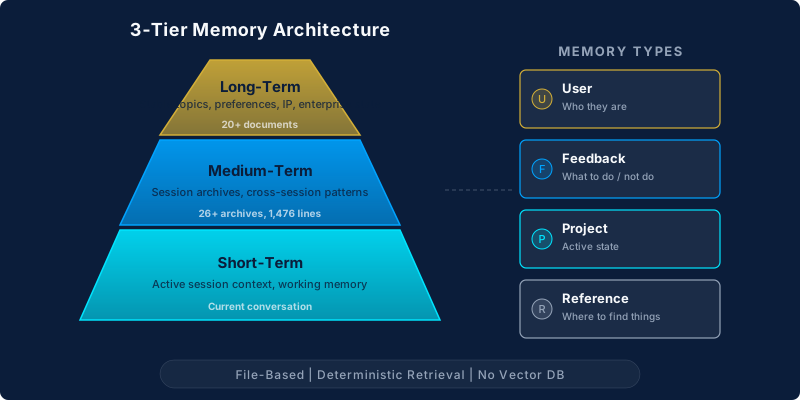
3-Tier Persistent Memory
A hierarchical, typed, self-correcting memory system. No embeddings. No vector databases. No similarity search. Deterministic retrieval -- every time.
Long-Term Memory
Stable knowledge. Persists across all sessions indefinitely.
Medium-Term Memory
Session archives and cross-session pattern recognition.
Short-Term Memory
Active session context. Current conversation state and working memory.
Typed, Not Tagged
Every memory has a type that determines when it is saved, how it is recalled, and what verification it requires before use. Four distinct types -- each with specific triggers.
User Memory
Commander preferences, behavioral directives, communication style rules. Saved when the Commander corrects behavior or states a preference. Recalled on every session boot.
Feedback Memory
Operational lessons learned. When something fails or a process improves, the feedback is captured as a standalone document with root cause and countermeasure. Permanent and never auto-expired.
Project Memory
Active project state -- deals, builds, deployments. Includes milestones, blockers, and next actions. Updated at session end when project work occurs. Subject to freshness rules.
Reference Memory
Infrastructure facts, API endpoints, credential locations, contact information. Updated when infrastructure changes. Verified before use via dead reference guard.
Deterministic, Not Probabilistic
Five architectural decisions that separate VindexAI memory from standard RAG.
File-Based, Not Vector-DB
Structured markdown with frontmatter metadata. The index (MEMORY.md) is always loaded at session start. Retrieval is deterministic -- the system knows exactly which file to read, not which embedding is closest. No similarity search. No hallucinated relevance.
Machine-Local, No Cloud Dependency
Memory lives on the machine, not in a third-party vector service. Two machines maintain independent sessions with bidirectional sync. No API latency. No vendor lock-in. No data leaving the perimeter unless explicitly pushed.
Container-Scoped Isolation
Six enterprises, each with its own memory container. Sub-agents spawned into a container can only access that container's memory. Financial data from one business never bleeds into decisions for another. Scoped by directory structure, not by access control lists.
Self-Correcting Freshness
Every memory file has a last-modified timestamp. If any MEMORY.md has not been updated in 7+ days, it is flagged as stale in the morning SITREP. The system does not silently act on old data -- it surfaces the age and forces a decision.
Dead Reference Guard
If a memory names a file, function, script, or endpoint, the system verifies it still exists before acting. No phantom dependencies. No executing against deleted infrastructure. If a reference is dead, it is logged and reported -- not silently skipped.
Cross-Enterprise Memory Architecture
Six enterprises linked under one orchestrator. Each container maintains its own memory scope. The global index connects them without bleeding context.
Each container has its own MEMORY.md, session archives, and topic files. Sub-agents are spawned into a single container and cannot read or write outside their scope. The global index references all containers but never duplicates their content.
End-of-Session Memory Lifecycle
Every session follows a strict four-step protocol to maintain memory integrity. No shortcuts. No skipped steps.
Archive
Write a timestamped session log to memory/archive/ with a descriptive filename. Captures what happened, what changed, and what decisions were made.
Update Index
Update MEMORY.md with the new archive entry, changed facts, and any new state. Enforce the 200-line cap -- trim oldest entries if necessary.
Promote Patterns
If a pattern has appeared across multiple sessions, promote it to topics/ as stable long-term memory. Topics persist indefinitely and inform all future sessions.
Trim
Direct file edits only -- no script dependencies. Remove superseded information. Keep the index lean and current. Overflow management is structural, not optional.
Production Numbers
Live since March 2026. Real operational data from a system managing six enterprises across two machines.
AI Memory Should Work Like Memory
Not like search.
RAG was a breakthrough for getting context into AI systems. But it was never designed to be memory. It was designed to be retrieval -- find the most similar chunk and inject it. That works for Q&A. It does not work for an AI system that manages six enterprises, tracks active deals, remembers operational lessons from three weeks ago, and needs to know that a specific credential was rotated yesterday.
VindexAI memory is built on a different premise: the AI should remember like a disciplined operator. It knows what it knows. It knows what is stale. It knows what has changed. It verifies before acting. And it never bleeds context across scope boundaries.
This is not a research paper. This is a production system. It boots every morning, reads its memory, checks for staleness, surfaces alerts, and executes missions across six enterprises. The memory architecture is what makes that possible.
Build AI That Remembers
VindexAI engineers deterministic memory systems for AI agents that operate in complex, multi-domain environments.