
From 52 to 95: A Two-Week SEO Transformation
How AI-powered execution and Lean Six Sigma methodology took a counseling practice from functionally invisible to ranking #1 on Google.
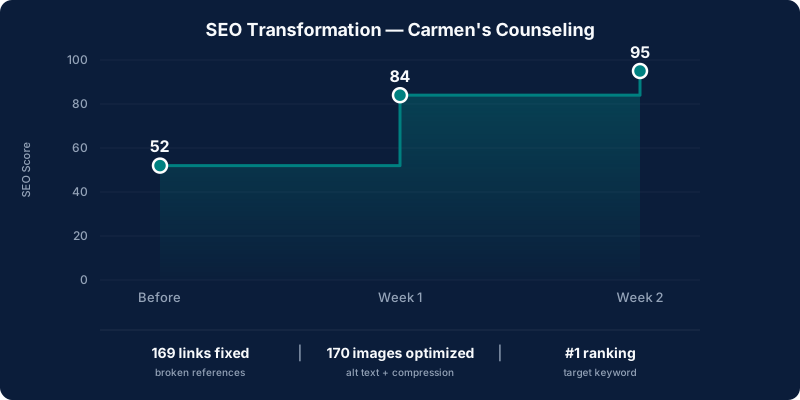
169 broken links. 170 images with no alt text. 19 bloated blog categories. That was the starting point.
Not a neglected site. Not a startup with nothing built. A live, functioning website for a licensed therapist with years of content, real traffic, and paying clients. The kind of site that looks fine on the surface but is hemorrhaging search visibility underneath because nobody ever did the foundational work.
Two weeks later, the SEO score was 95 out of 100, the site ranked #1 for its primary target keyword, and every single technical gap had been closed. Here is exactly how that happened.
The Baseline
The practitioner is a licensed therapist running a private practice across three states. Her website, the practice website, had been live for years on a managed WordPress host. It had 80 content items — pages, blog posts, media. It had a professional theme. It looked clean.
But looks are not search rankings. When we ran the initial audit, the numbers told a different story.
Initial Audit Findings
- 52/100 Overall SEO score
- 169 Broken links scattered across the site
- 170 Images with no alt text (~1% coverage)
- 19 Overlapping, unfocused blog categories
- 0 Schema markup of any kind
- 145 Total internal links (minimal for 80 pages)
The site was live but functionally invisible to search engines. Google was crawling it, finding broken links and missing metadata, and ranking it accordingly. The practitioner was getting clients through word-of-mouth and her church community, not organic search. That is a business running on one engine when it should have two.
Week 1 — The Audit and Build
52 to 84
We started where any serious SEO engagement should start: a complete inventory — the same approach we used to build 26 pages in a day for an industrial contractor. Not a sampling. Not a spot check. Every page, every post, every image, every link, every meta tag — cataloged and baselined. Eighty content items inventoried with 10 Critical-to-Quality metrics scored for each.
Then we fixed everything. In order.
Broken links: All 169 identified and resolved in a single session. Some were dead external links to defunct websites. Some were internal links pointing to pages that had been deleted or renamed years ago. Some were image references to files that no longer existed. Every one was tracked down and either repaired, redirected, or removed.
Image alt text: 170 images tagged with descriptive, keyword-informed alt text via the WordPress REST API. Not generic filenames. Not "image-1.jpg" descriptions. Each tag written to describe the image content while reinforcing the page's keyword strategy. This is the kind of task that takes an agency a full week of copy-paste. The API handled it in minutes.
Category consolidation: 19 blog categories collapsed to 7 focused, non-overlapping categories. This cleaned up the site's taxonomy, reduced duplicate archive pages confusing search crawlers, and gave the blog a coherent structure that signals topical authority.
Meta descriptions: Written for every page and post on the site. Each one unique, under 160 characters, incorporating the page's primary keyword naturally. These are the snippets Google shows in search results — they are your first impression and most sites have them blank or auto-generated.
Internal linking: 236 new internal links added across the site in a single pass, bringing the total from 145 to over 380. Internal links are the circulatory system of SEO — they tell Google what content is related, what pages matter most, and how the site's information architecture fits together. Most sites are dramatically under-linked.
Schema markup: FAQPage, Person, and BlogPosting structured data deployed across the site. Schema tells search engines what your content means, not just what it says. It is the difference between Google knowing you have a page about counseling and Google knowing you are a licensed therapist in Louisville who treats anxiety and accepts BlueCross.
End of Week 1: SEO score 84 out of 100. A 32-point jump. Zero broken links. Full alt text coverage. Clean taxonomy. Complete metadata. Strong internal linking. The foundation was done.
Score Progression
Week 2 — The Polish
84 to 95
With the foundation locked in, Week 2 was about building on top of it. The site had gone from broken to solid. Now it needed to go from solid to dominant.
church community landing page: We identified "regional church counseling" as a high-intent local keyword with low competition. The practitioner practices near one of the largest congregations in the region. We built a dedicated landing page targeting that keyword — credential-rich copy, location-specific schema, therapist-to-congregation relevance, and deep internal links from related blog content. The page went live and ranked #1 within days.
Content optimization: Nine new blog posts published, each targeting specific long-tail keywords in the counseling space. Five new landing pages targeting local service variations. Every piece fully optimized at birth — meta descriptions, schema, internal links, alt-tagged images, proper heading hierarchy. No content debt from Day 1.
Final internal linking pass: A second sweep brought the total internal link count to over 380, with every new piece of content woven into the existing structure. The site went from a collection of disconnected pages to a tightly interlinked network where Google can follow clear topical paths.
End of Week 2: SEO score 95 out of 100. CTQ score 10 out of 10. #1 ranking for the target keyword. Zero broken links. Zero missing metadata. Full schema coverage. The site went from 80 content items to 95, and every single one was fully optimized.
The Honest Truth
"Our SEO results look extraordinary. They're not. They're what happens when someone actually does all the work."
Every SEO agency knows this checklist. Fix broken links. Write alt text. Add meta descriptions. Build internal links. Deploy schema. Create targeted content. Optimize heading structures. None of this is secret. None of it is innovative. It is the blocking-and-tackling of search engine optimization, and it has been well-documented for a decade.
The problem is not knowledge. The problem is execution. Agencies quote six-month retainers because the work is tedious, repetitive, and unglamorous. Tagging 170 images is not fun. Auditing 169 broken links is not fun. Writing 80 unique meta descriptions is not fun. So it gets spread across months, assigned to junior staff, and half of it quietly never gets done.
We did all of it. In two weeks. Not because we know something agencies do not. Because AI does not get bored. It does not skip the tedious steps. As we explain in Our SEO Results Look Extraordinary — They Are Not, the difference is execution model. It does not decide that 80% coverage is good enough and move on to the next client. It finishes.
Why AI + Methodology
AI alone is fast but unfocused. Methodology alone is rigorous but slow. Combined, they become something neither can be independently: thorough AND fast.
The AI handles the labor that makes humans cut corners. Tagging 170 images with descriptive alt text. Adding 236 internal links across 80 pages. Writing meta descriptions that are unique, under 160 characters, and keyword-aware. Deploying schema markup to every content type on the site. This is the work that agencies bill 40-60 hours for, spread across weeks, and still miss 15-20% of.
The Lean Six Sigma methodology ensures the RIGHT work gets done first. Without it, AI would optimize indiscriminately — polishing meta descriptions while 169 broken links silently tank the site's crawl efficiency. The methodology provides the sequence: Audit first. Measure everything. Identify the critical few. Execute in priority order. Verify against the baseline.
The Execution Loop
Full inventory. Every page, link, image, tag.
Baseline every CTQ metric. Define targets.
Programmatic execution via API. Zero shortcuts.
Re-measure every metric. Prove the results.
This is not a pitch for AI magic. It is an argument for doing the work — all of it — and using AI to make "all of it" feasible on a timeline and budget that small businesses can actually afford.
The WordPress REST API Advantage
Here is a dirty secret about most SEO work: it is done manually through the CMS admin panel. A human clicks into each page, scrolls to the meta description field, types something, clicks save, and moves to the next page. Eighty pages at three minutes each is four hours of mind-numbing click work — and that is just meta descriptions.
The WordPress REST API eliminates this entirely. Every content update — alt text, meta descriptions, schema markup, internal links, category assignments — can be deployed programmatically. Batch operations that would take an agency a week of click-through-the-CMS labor execute in minutes via authenticated API calls.
This matters beyond speed. Programmatic deployment is consistent. It does not accidentally skip a page. It does not misspell "counseling" on page 47 because the junior SEO is tired. It does not forget to save. It applies the same standard to every single item, every single time.
The practice site runs on managed WordPress hosting with no SSH access and no WP-CLI. The client has Editor-level access, not Administrator. Every optimization we shipped went through the REST API — the same front door any authorized user would use, just at machine speed. No special access. No server modifications. No plugins installed.
If your site runs on WordPress, the API is already there. The question is whether anyone is using it.
What This Means for Your Site
The practice site was not uniquely broken. It was typically broken — the same gaps we see on almost every small business website. Missing alt text. Thin meta descriptions. Weak internal linking. No schema. Broken links accumulating quietly over years.
The 52-to-95 transformation was not extraordinary. It was the result of actually doing every item on the checklist that every SEO knows but nobody finishes. AI makes it possible to finish. Lean Six Sigma makes it possible to finish the right things in the right order.
Your site has the same gaps. We fix them the same way.
Published April 2026. Based on a real engagement completed March 29 – April 3, 2026. All metrics measured and verified.